ChatGPT, Claude, Gemini, Grok: the map of what each AI company sells
Astra, dots, Codex, Spark, Muse, Grok Bot: every AI company sells the same five things under different names. One grid to place any product and the next launch.
In September alone, OpenAI shipped Astra, Sol, Luna, dots, Codex cloud environments and a thing called ChatGPT Space. Meta shipped Muse. Google had already shipped Spark, xAI had shipped Grok Bot, and Anthropic had shipped Cowork. If you felt you’d lost track of what these words mean and which ones compete, that’s reasonable. They don’t line up by name. They line up by what kind of thing they are, and there are only five kinds.
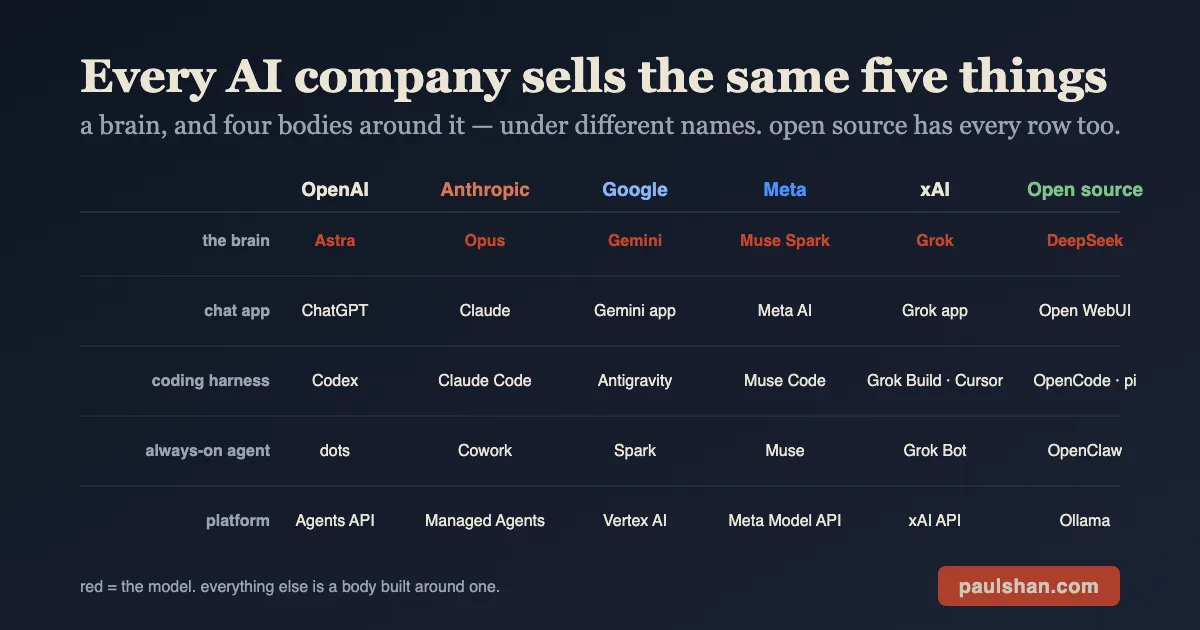
Every AI company sells the same five things
An AI company’s product line is one brain and four bodies: a model, a chat app that wraps it, a coding harness that wraps it for a repository, an always-on agent that wraps it with its own computer, and a platform that rents the brain and the bodies to builders. The names differ. The rows don’t.
This is the split I’ve used through my harness series: the model is the brain, the harness is the body, and the body decides what the brain can actually do. Here it’s applied to the whole market.
Here’s the whole map, as of October 6, 2026. Three of these cells changed in the eight weeks before that date, so treat it as a snapshot; the rows are what lasts. The rest of the essay walks it one row at a time.
| OpenAI | Anthropic | Meta | xAI | Open source | ||
|---|---|---|---|---|---|---|
| The brain (models) | GPT-6 Astra, Sol, Luna | Claude Fable 5.1, Opus 5.5, Sonnet 5.5, Haiku 4.5 | Gemini 3.1 Pro, 3.5 Flash | Muse Spark 1.3, Llama 4 | Grok 4.7 | DeepSeek V4, Kimi K3, Qwen3, Llama 4 |
| Chat app | ChatGPT | Claude | Gemini app | Meta AI | Grok | Open WebUI, LibreChat |
| Coding harness | Codex | Claude Code | Antigravity | Muse Code | Grok Build, Cursor | OpenCode, pi, OpenHands, Cline |
| Always-on agent | dots | Cowork | Gemini Spark | Muse | Grok Bot | OpenClaw, Hermes |
| Platform | Responses and Agents API | Claude Platform, Managed Agents | Gemini API, Vertex AI, Antigravity SDK | Meta Model API, Llama weights | xAI API | Ollama, vLLM to run the brain; LangGraph, pi to build the body |
One naming note: xAI was bought by SpaceX in February 2026 and renamed SpaceXAI; I’ve kept “xAI” because that’s still the name on the products.
| Row | What it is | The question it answers |
|---|---|---|
| The brain | the model: text in, text out, no hands | which model is this? |
| Chat app | a conversation around the model, with memory and a browser | what do I open to talk to it? |
| Coding harness | the model given a terminal, a repository and tests | what do I run on my code? |
| Always-on agent | the model given its own computer and a goal | what works for me while I’m away? |
| Platform | the model, and sometimes the body, for rent to builders | what do I build on? |
Three things to notice before the detail. Every column is full, including the open-source one. In four of the five vendor columns, the newest cell is the always-on agent, which is the row this map didn’t have a year ago. And the open-source column is the only one whose bodies take any brain, which is the subject of the whole series and why it gets a column of its own.
The brain: Astra, Opus, Gemini, Muse Spark, Grok
A model is a function from text to text. It has no memory between calls, no files, no browser, no hands. That is the whole definition, and everything confusing about the product names follows from forgetting it. Astra can’t open your email. ChatGPT, with Astra inside it, can.
Each vendor sells its brain in tiers, and the tiers are more alike than the names suggest. Vendor names don’t line up with each other, so this table tiers by list price per million input tokens, which is the only scale they share:
| Tier (by input price) | OpenAI | Anthropic | Meta | xAI | Open weights | |
|---|---|---|---|---|---|---|
| Top, about $10 | GPT-6 Astra | Claude Fable 5.1 (Mythos 5.1 for an approved program) | Gemini 3.5 Pro, announced in May and not shipped | — | — | — |
| Workhorse, $1.25 to $4 | GPT-6 Sol, GPT-6.1 Sol | Claude Opus 5.5, Sonnet 5.5 | Gemini 3.1 Pro, 3.5 Flash | Muse Spark 1.3 | Grok 4.7 | DeepSeek V4 Pro, Kimi K3, Qwen3, GLM-5, Llama 4 Maverick |
| Small, up to $1 | GPT-6 Luna | Haiku 4.5 | Gemini 3.1 Flash-Lite | — | — | DeepSeek V4 Flash, Mistral Small 4, Gemma |
The naming is where most of the confusion starts. “GPT-6” is a family; Astra, Sol and Luna are three members at three prices, and 6.1 Sol is a revision of the middle one. Anthropic uses the same pattern with different words: Fable, Opus, Sonnet, Haiku are tiers, and the number after each is the generation. Google splits Pro from Flash. Meta did something different in April: its best model, Muse Spark, is closed, while the Llama line it’s known for stays open-weight. xAI ships one model at a time and versions it. Notice that the middle band holds most of the market: Opus 5.5, Sonnet 5.5, Sol, Gemini 3.1 Pro, Grok 4.7 and Muse Spark are all priced within a factor of four of each other, and only two vendors sell anything above it. The open-weight column is the same shape with the vendor removed: DeepSeek, Moonshot’s Kimi and Alibaba’s Qwen publish weights you download and run yourself, and the top of that column now sits within reach of the vendors’ mid tier. Meta’s Llama used to lead it; since April it’s one entry among several.
The proof that a brain is only a brain is cheap to run. I took Astra, put it inside my own Node.js harness, the one I’ve used all series, with six tools of mine and none of OpenAI’s, and gave it a real task from my weather-station project:
USER: Ops wants a monthly rollup for station BSL-04. Write a new script, monthly.js …
TOOL list_dir({})            → README.md (518 bytes) | calibration.log | config.json | docs/ | readings.csv (238 KB) | report.js
TOOL read_file(README.md)    → # Station BSL-04 … rows with -999 are sensor dropouts, never measurements
TOOL read_file(report.js)    → // report.js — daily summary …
TOOL run_command(head -n 8 readings.csv) → timestamp,station,temp_c,humidity,wind_kph …
TOOL read_file(docs/sensor-faq.md) → **Why do some rows read -999?** …
ASTRA: I'll group readings by calendar month, exclude the documented -999 dropout rows, and check the results …
TOOL write_file(monthly.js)  → Wrote 2052 bytes to monthly.js.
TOOL run_command(node monthly.js) → 2026-07,18.38,51.75,10.94 | 2026-08,18.38,52.15,11.12
ASTRA: DONE                  ← verifier: correct, 6 turns
No ChatGPT, no Codex, no dots. The same loop ran Claude last week. Which tells you what the brain row is: interchangeable parts, priced by tier. It’s the bodies that differ.
The chat app: ChatGPT, Claude, Gemini, Meta AI, Grok
A chat app is the body most people mean when they say the brand name: a conversation, a memory of you, a browser, file upload, voice, and a model underneath that the vendor swaps as it pleases. When OpenAI “upgraded ChatGPT with Astra”, the body stayed and the brain changed. That’s why “Astra” and “ChatGPT” get used as synonyms and aren’t.
| OpenAI | Anthropic | Meta | xAI | Open source | ||
|---|---|---|---|---|---|---|
| Product | ChatGPT | Claude | Gemini app | Meta AI | Grok | Open WebUI, LibreChat |
| Where it lives | web, desktop, mobile, plus ChatGPT Space for teams | web, desktop, mobile | web, mobile, inside Search and Workspace | WhatsApp, Instagram, Messenger, a standalone app | grok.com, inside X, mobile | your own server |
| Extends into | plugins with sidebars and panels | Claude in Chrome, Claude for Microsoft 365 | Gemini in Chrome, Gmail, Docs | the glasses and the headsets | X itself | any model, any provider, your documents |
Comparing chat apps is a fair fight only within this row. “Is ChatGPT better than Claude?” is a question about memory, tools, the browser, the plan limits and the voice, with the model as one input among six. The same question about Astra against Opus is a different row, and the answer can go the other way.
The distinctive feature of this row is distribution, not capability. Meta AI isn’t the best chat app; it’s inside WhatsApp. Grok is inside X. Gemini is inside Search. The chat app is where each company puts the brain in front of the people it already has. The open-source cell makes the row’s point in reverse: Open WebUI is a chat body with no brain of its own, and you plug in whichever model you like, hosted or local. Same conversation, memory and file upload; the brain is a setting.
The coding harness: Codex, Claude Code, Antigravity, Muse Code, Grok Build
A coding harness is a body shaped for a repository: a terminal, file read and edit, a way to run tests, a sandbox, and usually several of those in parallel. Same brain as the chat app, completely different hands. This is the row people most often confuse with the brain row, because the products carry model-like names.
| OpenAI | Anthropic | Meta | xAI | Open source | ||
|---|---|---|---|---|---|---|
| Product | Codex | Claude Code | Antigravity | Muse Code | Grok Build, and Cursor since August | OpenCode, pi, OpenHands, Cline, Aider |
| Surfaces | CLI, desktop app, IDE extensions, cloud environments, inside ChatGPT, GitHub | CLI, desktop app, IDE, web | desktop app, IDE, CLI, SDK | CLI, in beta | terminal, headless, editor protocol; Cursor’s editor | terminal, IDE extension, headless in CI |
| Brain inside | OpenAI’s current models, including Codex-tuned variants | Claude models | Gemini, and Claude or open models if you choose | Muse Spark 1.3 | Grok 4.7, or another model by config | any: hosted or local |
| Shipped | April 2025, native in ChatGPT since July 2026 | 2025, mods added October 2026 | November 2025, 2.0 in May 2026 | August 2026 | May 2026 | 2023 onward |
Two cells in that table matter more than the rest. Antigravity, Google’s harness, will run Claude or an open-weight model instead of Gemini. Grok Build will take another model by config. Two of the five vendors ship a coding body that accepts a competitor’s brain, which is the clearest admission in the whole map that the brain and the body are separate products. The open-source column has always worked this way; that’s its entire pitch. OpenCode is the most-starred, a polished terminal body that takes any hosted or local model. Pi is the one I’d point an engineer at: a deliberately minimal harness, four built-in tools, everything else an extension, which makes it the clearest teaching example of what a coding body actually is. OpenHands runs headless in CI, Cline lives in the editor, Aider makes git-native edits. Cursor used to be the big commercial independent in this row. SpaceX bought it for $60 billion in a deal that closed on August 14, which moves it into the xAI column, and OpenAI has said it will stop serving its models through Cursor in November. A body that takes any brain just lost one of them, because the body changed owners. That’s the brain-and-body split with a corporate-development twist.
The second thing to see: Codex is not a model. There was once a model called Codex, in 2021, and OpenAI has shipped models with “Codex” in the name since. But the product called Codex today is the body: the CLI you install, the app, the cloud environment that runs a task while your laptop is shut. Astra is what’s inside it this month.
The always-on agent: dots, Cowork, Spark, Muse, Grok Bot
An always-on agent is a body with its own computer. You give it a goal rather than a message, it keeps working after you close the app, and it comes back when it needs a decision. This is the newest row, and four of the five vendors filled it between May and September this year.
| OpenAI | Anthropic | Meta | xAI | Open source | ||
|---|---|---|---|---|---|---|
| Product | dots | Claude Cowork | Gemini Spark | Muse | Grok Bot | OpenClaw, Hermes |
| Shipped | September 29, 2026 | preview January 12, 2026; general availability April 9 | announced May 19, 2026 | September 8, 2026 | August 11, 2026, beta | November 2025; Hermes February 2026 |
| Its own computer | yes, cloud computer and browser | a built-in browser; your files and tools | yes, a VM in Google Cloud | yes, a cloud VM with a file system, a terminal and a browser | yes, a cloud computer it signs into apps with | yours: it runs as a daemon on your machine or server |
| Talk to it from | ChatGPT, Slack, Teams, voice calls | the Claude apps | the Gemini app, Gmail, Workspace | its own app, WhatsApp, web | desktop and iOS | WhatsApp, Telegram, Discord, Slack, iMessage, Signal, the terminal |
| Who gets it | Pro and Business Premium, plus Enterprise once an admin turns it on; not the EEA, Switzerland or UK yet | Pro, Max, Team, Enterprise | US Google AI Ultra, beta | US only, 18 and over | three subscription tiers, beta | anyone; you pay the model’s API bill |
| Aimed at | everyone | knowledge work: reports, spreadsheets, contracts | your digital life, Gmail first | consumers: shopping, booking, email, payments | teams: an AI colleague with its own logins | people who want the agent on their own hardware |
The cells aren’t identical. Dots, Spark, Muse and Grok Bot are all pitched as agents that live on a computer somewhere and run around the clock. Cowork is pitched as an assistant for office work that you can leave running on a schedule; it has a browser and your files, and it “runs when you don’t”, but it’s a desk, not a colleague. I’ve put it in this row because it’s Anthropic’s answer to the same question, and because the honest version of the map has one cell that’s a different shape.
What’s shared is the architecture, and it’s the thing that makes this row expensive to build. A chat app needs a model and a web page. An always-on agent needs a machine per user, logged into that user’s accounts, running a loop that doesn’t stop. Google’s own launch post says Spark runs on Gemini 3.5 and uses the Antigravity harness, which is the brain-and-body split in the vendor’s own words: they took the coding harness’s body and gave it a Gmail account. OpenAI’s version is the same move: the Agents API exposes the Codex harness, and dots is that body with a consumer skin. At two vendors, the coding body became the always-on body.
This row is also where the vendors are fighting now. Dots was announced against Muse. Muse was announced against Spark. Each one leans on the distribution its company already has: dots on ChatGPT’s users, Muse on WhatsApp, Spark on Gmail, Grok Bot on the enterprise seats xAI is trying to win. The brain row will keep changing names every few months. This row changes what an ordinary person can delegate.
The open-source cell is the tell for how much demand there is. OpenClaw is a persistent agent that runs on your own machine, reachable from whichever messaging app you already use, with any model behind it. It passed 250,000 GitHub stars within about three and a half months of launch, overtaking React, before dots, Muse or Grok Bot existed. Hermes, from Nous Research, is the same idea with a stronger memory story, and the second-largest project in this row. People wanted the body before the vendors sold one.
The platform: renting the brain, and renting the body
The platform row is how each company sells to people who build rather than use: the brain by the token through an API, and increasingly the body as well, as hosted execution you call rather than run. This is the row that matters if you’re the one writing the harness.
| OpenAI | Anthropic | Meta | xAI | Open source | ||
|---|---|---|---|---|---|---|
| The brain for rent | Responses API | Claude Platform | Gemini API, Vertex AI | Meta Model API for Muse Spark 1.3; Llama 4 weights to download | xAI API | Ollama and vLLM, to run any open weights yourself |
| The body for rent | Agents API: managed execution, computer use, tool search, compaction | Managed Agents: hosted sessions with a sandbox, plus the Agent SDK | Antigravity SDK, Agent Development Kit | — | — | LangGraph, the pi toolkit, the Vercel AI SDK: loops you run yourself |
The second line is the one that’s new. A year ago every platform sold tokens. Now three of them also sell the loop: send a task, get back a finished session, with the sandbox, the tool calls and the retries handled on their side. It’s the same body as dots or Spark, with the consumer skin removed and a price per session put on it.
For a builder, that’s the row where the real decision sits, and it’s the decision my whole series is about: rent the brain and own the body, or rent both. Owning the body is work, and it’s where the engineering compounds. Renting it is faster, and it welds you to one column of this table. The open-source column is what owning looks like: Ollama or vLLM to serve a brain on your own hardware, and a loop you wrote, or one from pi or LangGraph, around it.
How to read the next launch
Every announcement from here on is either a new brain or a new body, and the first question is which. A new brain changes a name in row one and, within a quarter, gets dropped into every body the company already has. A new body changes what you can do, and takes a year to copy. So:
- Find the row. Model, chat app, coding harness, always-on agent, or platform. If the announcement says “model” or has a version number, it’s row one. If it has its own computer, it’s row four.
- Find the peer. Compare across the row, never down a column. Astra against Opus. Codex against Claude Code. Dots against Spark and Muse.
- Ask what’s inside. For any body, ask which brain it’s running this month, and whether you can change it. Two vendor coding harnesses on this map will take a competitor’s model, and every open-source body takes any model. None of the vendors’ always-on agents will, yet; OpenClaw does.
- Ask who it’s for. The same row serves different people in different columns: Grok Bot is for a team, Muse is for a shopper, Cowork is for an analyst. The product name won’t tell you; the “who gets it” line will.
A worked example from the week this was written. OpenAI announced “GPT-6.1 Sol, dots, Codex cloud environments, ChatGPT Space, computer use in the Agents API”. Sorted: one brain (6.1 Sol, row one, a revision of the mid tier), one new body (dots, row four), two upgrades to existing bodies (Codex, row three; ChatGPT, row two), and one body feature for rent (row five). Five names, nothing you can’t place.
The companies will keep inventing words. The grid won’t change until someone invents a sixth kind of thing to sell. When that happens, it’ll be a new row, and it will be obvious, because it won’t fit in the five.