Trump's true ambition: break America's global liquidity tap
America built global prosperity by exporting its demand and drowning in debt. Trump's real project is shutting that liquidity tap — whatever it costs.
Part 2 of the New World Equation series. Part 1 is here.
A village man once sold simple, tasty cookies. His small shop made enough to live on — until a city mall owner tasted one and was hooked. He offered the seller a spot in his upscale mall, calling it a great opportunity. But deep down he had a selfish reason: he wanted easy, daily access to cheap, delicious cookies — without ever paying a premium.
The seller moved in, and business boomed. For decades he thrived, earning far more than he ever could back home. Thanks to the mall owner.
But one day the mall owner realized he was drowning in debt. He had built the mall with borrowed money and now faced bankruptcy. Scrambling for cash, he noticed the cookie seller had prospered but never bought anything from the mall. He only sold.
So the mall owner hiked the rent sharply.
“Your success came through me,” he said. “Now I need to save myself. No more easy deals.”
The game had changed.
This is the story of America — the mall owner — and the many cookie sellers of the world: China, Vietnam, Bangladesh, and countless others who rose by tapping into the liquidity of the U.S. economy.
How America fueled global growth — and became its centerpiece
The cookie story is a simplified version of what’s unfolding in the real world. To grasp what’s happening today, you need to understand how the United States came to power not just militarily or diplomatically, but financially — how it fueled global growth and, in return, became the anchor of the world economy through an ever-growing mountain of debt.
America’s rise as a global trade and financial power began after World War II. Europe was in ruins, Asia was rebuilding, and the U.S. stood tall with unmatched industrial capacity and a stockpile of gold. The Bretton Woods system, established in 1944, made the dollar the centerpiece of the global monetary system — pegged to gold, with other currencies pegged to the dollar.
The real shift came in the 1970s, when the dollar was untethered from gold. Instead of collapsing, it evolved. Debt replaced gold as the foundation of global trust. America began running massive trade and fiscal deficits. But rather than being punished, it was rewarded — because the world needed dollars, and the U.S. was willing to create and distribute them. Debt became a feature, not a bug.
This created a system where countries like China, Vietnam, and Bangladesh didn’t need to solve the hardest problem in economics — domestic demand. They could skip it. All they had to do was produce. America, with its endless appetite and expanding debt, took care of the rest. Its consumers bought the goods. Its deficits pushed dollars into global circulation. Its Treasury market soaked up foreign savings.
Debt became the fuel — the essential lubricant of the global engine. The more America borrowed, the more dollars flowed outward. The more dollars the world received, the more it prospered — and the more it reinvested into U.S. debt, completing the loop.
That cycle produced decades of rising globalization, rapid industrialization across the Global South, and soaring asset prices. It wasn’t just globalization — it was debt-backed globalization, with the U.S. at the center, quietly holding up the entire structure.
The cracks in the dollar machine
For decades, the strategy worked like magic. By running huge deficits and borrowing endlessly, the U.S. didn’t just grow its own economy — it became the anchor of global prosperity. Trillions flowed out, creating jobs in China, factories in Vietnam, ports in Africa. In return, the world saw America as a trusted leader, a global buyer, and the dollar as a safe store of value.
But now there are cracks in the system:
- Interest payments on U.S. debt have crossed $1 trillion annually.
- Debt-to-GDP has hit 125% — the highest in American history.
- And the U.S. economy isn’t growing fast enough to justify it.
At first glance, some might shrug: the U.S. issues the world’s reserve currency — it can print forever, right?
But here’s the truth: money is a belief system. A reserve currency is a contract of trust — a belief that the issuing country will remain stable, responsible, and dominant for the foreseeable future.
That trust is visibly eroding.
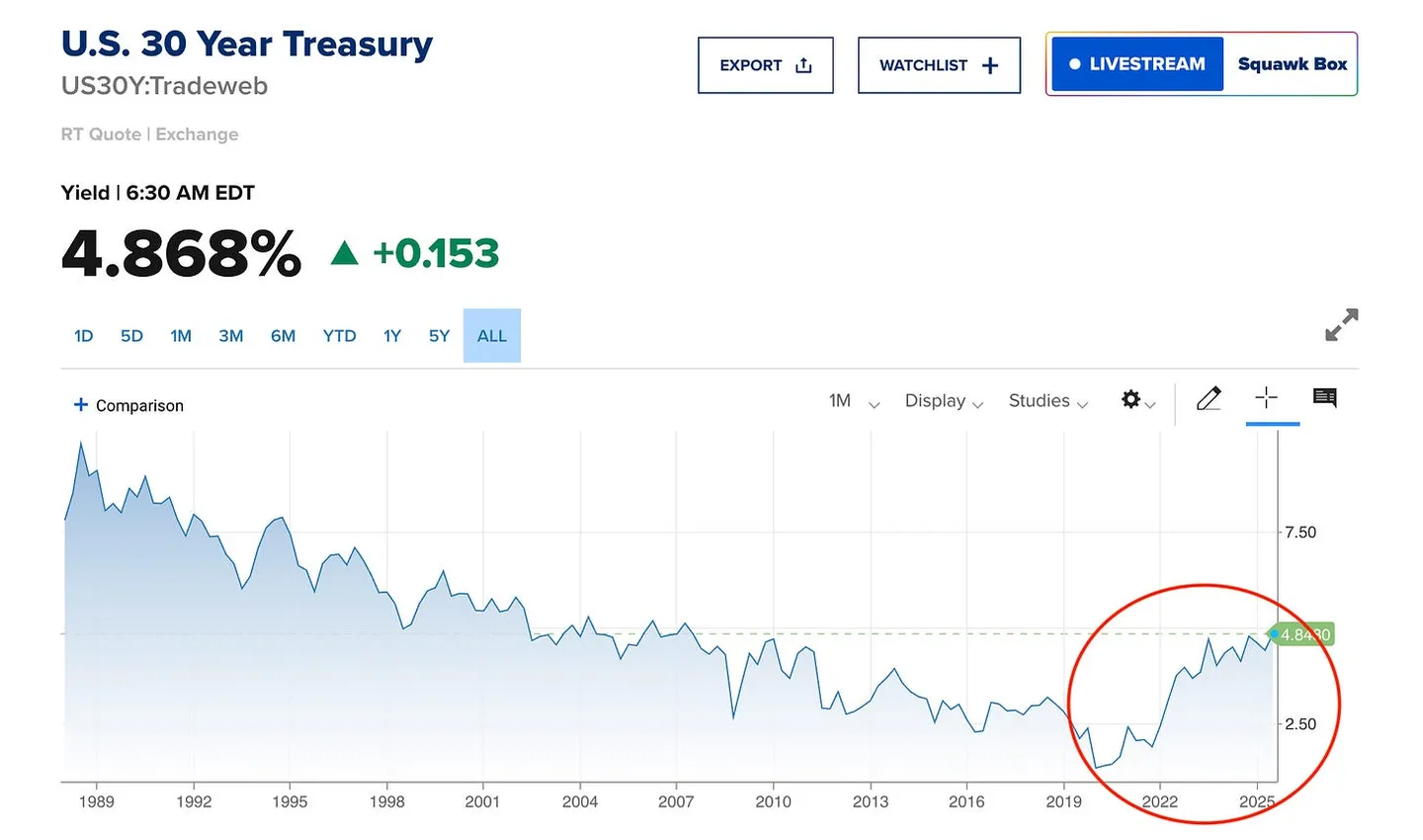
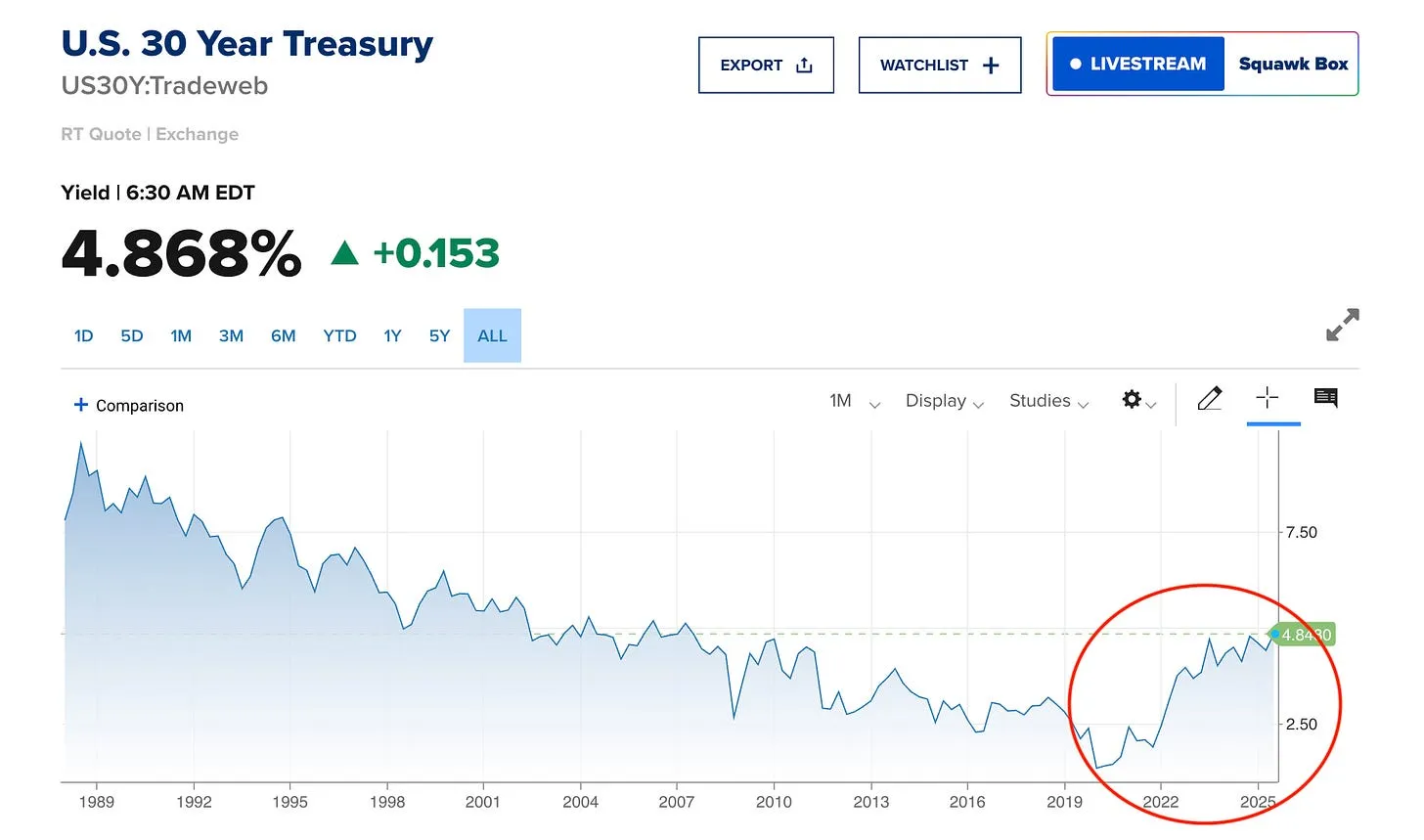
The bond market says it all. The 30-year Treasury yield, falling steadily since the 1990s, started bouncing back after 2020. That’s not a data point — it’s a signal. Demand for U.S. bonds is falling, which means the world no longer trusts the U.S. economy like it used to. Higher yields are simply higher risk premiums.
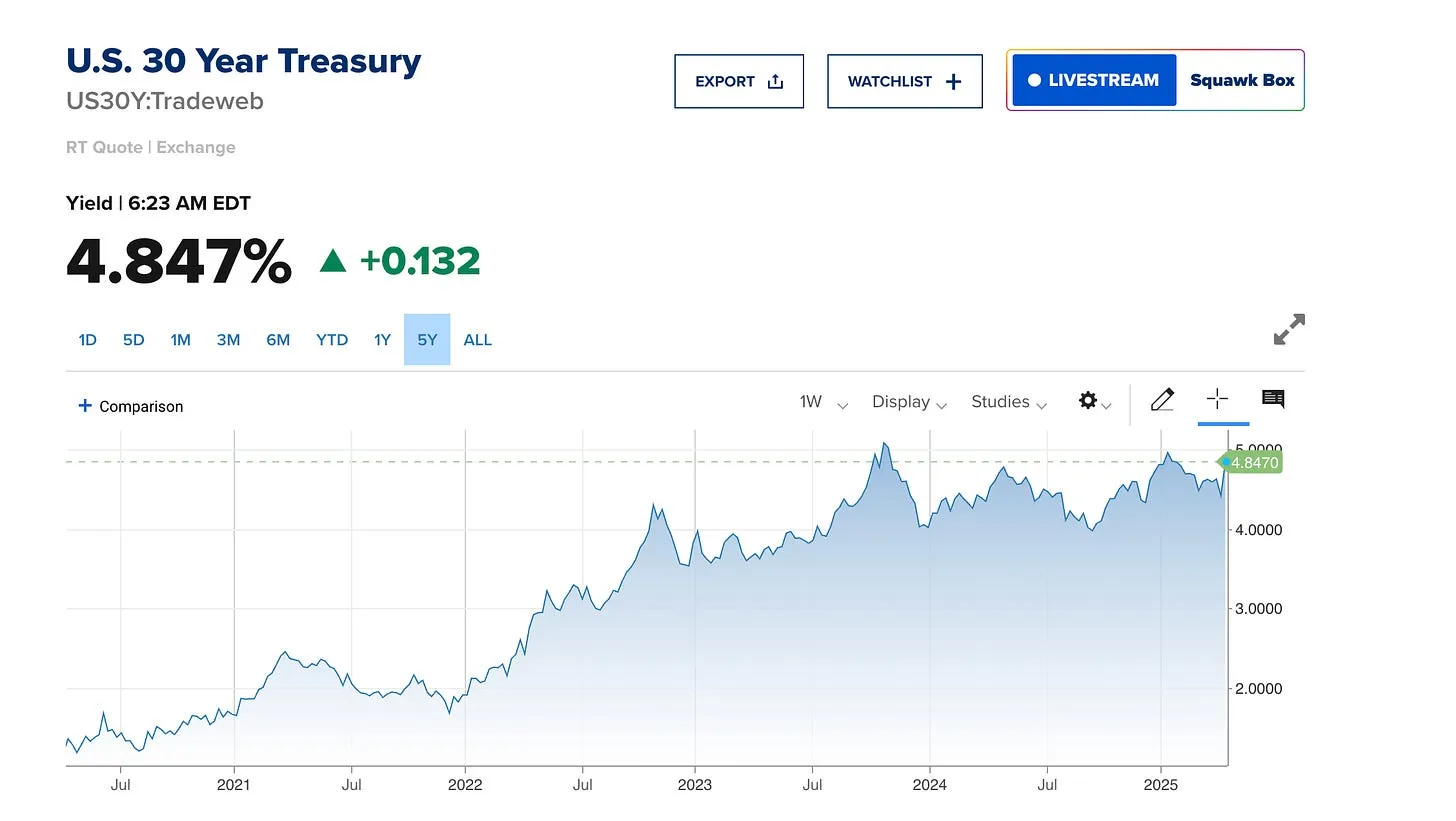
The loop — America spends, the world exports, surplus nations fund U.S. debt — is no longer running smoothly.
And rightly so. America today shows deep structural stress, both internally and globally:
- It struggles to manufacture even basic goods — including critical defense and semiconductor components.
- The wealth gap between the top 1% and the rest has become socially and politically explosive.
- Its geopolitical dominance is fading — visible in Ukraine, Gaza, and a muted presence in Asia.
- China’s rise is prompting many nations to rethink American dominance.
- The freezing of Russia’s dollar reserves in 2022 shattered the illusion of dollar neutrality.
- Saudi Arabia, China, and others are scaling back U.S. bond purchases — weakening the very engine that made the dollar system feel infinite.
The dollar machine isn’t working anymore.
Trump’s real ambition
So what happens now?
The system needs a serious fix. The very liquidity tap that powered U.S. supremacy has become its biggest curse.
And President Trump knows it.
He believes the old infinite-liquidity tap can’t be repaired. It must be broken. And more importantly — he’s bold enough to break it.
Trump doesn’t want to borrow to make the world prosper. He wants to borrow only to make America prosper. Going forward, every dollar of liquidity America prints should benefit American GDP alone. The era of America subsidizing global growth in exchange for soft power is over.
No more shared prosperity. You take a slice of my GDP, you buy something from me and return it. That’s the bottom line.
No more acting as the world’s buyer of last resort.
Because now America has to fix its own debt problem. And to do that, it must stop exporting its demand and start hoarding its GDP.
That’s the ambition of the boldest president in recent memory.
Of course, this path has consequences. Closing borders and turning protectionist can disrupt supply chains, fuel inflation, and slow growth. It could trigger a short recession — or a prolonged slowdown, a depression, even conflict between countries.
But at least the question has changed — from “America will die” to “Will America die?”
Interesting times ahead. This is the beginning of the new world equation.
Part 3: how countries reposition in the new equation →
First published on Seeker Capital’s Substack.