Decoding Trump's plan: the debt awakening
Why the tariff shock isn't madness — a conversation tracing America's debt problem to the UK's post-empire playbook, and the six moves that follow.
Part 1 of the New World Equation series.
Since February 13th, when President Trump first floated the idea of reciprocal tariffs, I brushed it off as a strategic bluff — a marketing tactic designed to pressure other countries into reducing their tariffs and leveling the playing field for U.S. businesses. It felt like classic Trump: loud, provocative, but ultimately a negotiation move.
Then came April 2nd.
That’s when Trump dropped the hammer with a 26% tariff specifically targeting India. I was stunned. Honestly, I expected something symbolic — maybe a 10% hike at most. But 26%? That wasn’t just aggressive; it was a clear escalation.
What shook me even more wasn’t the size of the tariff — it was how it was calculated. For months, Trump had been preaching “tariff equality.” So naturally, I assumed these moves would be based on matching tariffs country-by-country. Instead, the tariffs were pegged to trade deficits, not tariff disparities. That completely flipped the narrative.
At that moment, I realized I was missing something. Maybe a lot of us were.
A sweeping tariff war against nearly every trade partner looks like economic suicide for the U.S. And Trump, whatever people think of him, isn’t stupid — he surrounds himself with some of the sharpest operators in business. So there had to be a deeper logic at play.
That’s when I knew I had to rethink everything. Go back to the drawing board. Start from scratch.
Digging deeper: finding the real tone
To make sense of Trump’s actions, I went back to his old interviews and campaign speeches. I also revisited some of Elon Musk’s conversations — not to find specific facts, but to feel the emotional undertone.
What stood out was a shared, urgent message:
“America is going bankrupt. We need to save America — now.”
That shifted my entire perspective. I began connecting the dots with this idea as the backbone.
What followed was a long, thought-provoking conversation with my friend, Mr. O.
The conversation with Mr. O
Mr. O: Why would the U.S. go bankrupt?
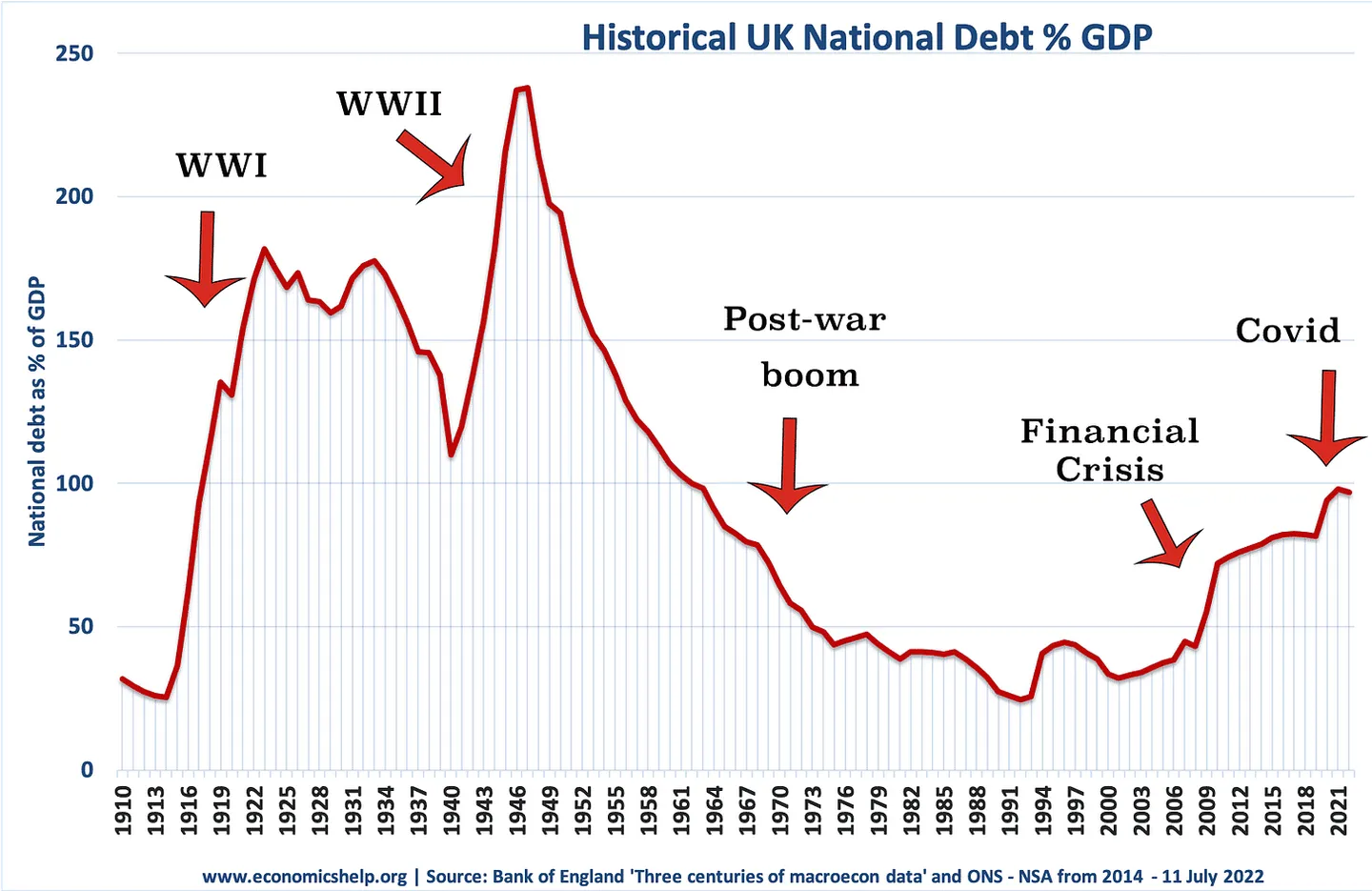
Me: Because the debt-to-GDP ratio is already around 123%. Debt destroys global leadership. At the end of Britain’s supremacy, their debt-to-GDP hit 250%. So yes, the U.S. still has some time — but the situation needs to be addressed now.
Mr. O: But the UK never officially went bankrupt, even at 250%. They eventually pulled up GDP by relying on U.S. loans. Over time the ratio dropped even though the debt stayed. They came close in the 1970s but never crossed the line. So what’s the problem?
Me: The problem is they had to surrender global leadership. The U.S. doesn’t want to repeat that. And the timing matters — China hasn’t cracked domestic consumption yet. So there’s a unique window where even if the U.S. takes a financial hit, China still might not be ready to take over. That gives the U.S. a chance to reset without losing dominance.
Mr. O: Okay, makes sense. But why did the UK take on so much debt in the first place?
Me: Wars. Being a global leader comes with massive expenses — maintaining bases worldwide, fighting wars, funding allies. Here’s the UK’s debt-to-GDP over time:
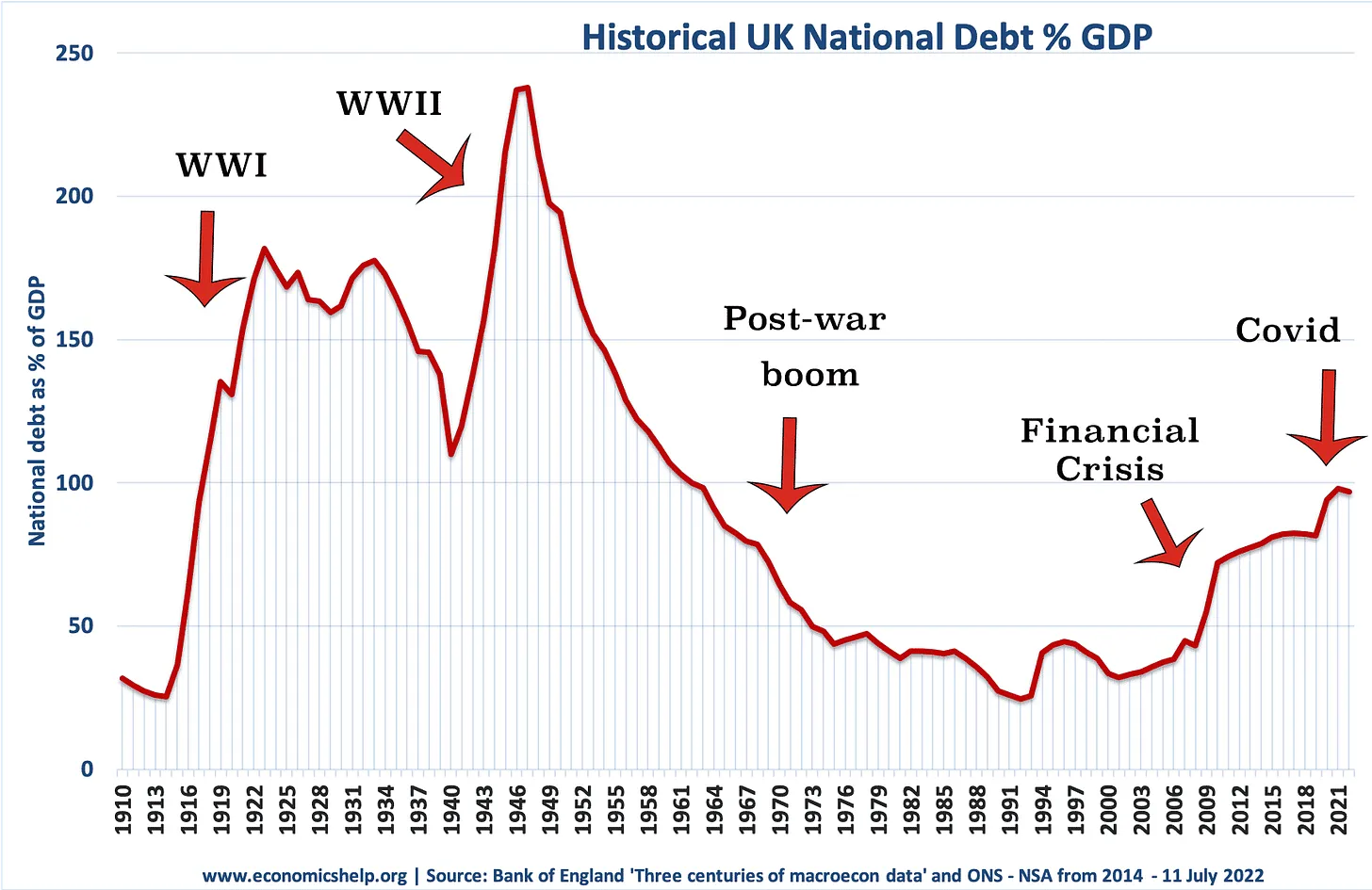
Mr. O: Wow — they actually reduced debt-to-GDP significantly post-war. How did they pull that off?
Me: A mix of factors. The biggest ones:
- Low interest rates
- Long-term debt (50+ years)
- Moderate inflation, which eroded the real debt burden
- Industrial growth and an export boom
- Tight fiscal spending
They also cut costs by ending colonial commitments — pulling back from expensive overseas territories. Plus the Marshall Plan (1948–1952), funded by the U.S., helped the UK rebuild its infrastructure and industry. More exports, better jobs, higher wages, stronger tax revenues. GDP grew, and the ratio came down.
Mr. O: This is wild. A lot of that sounds like what Trump is trying to do right now.
Me: Exactly. He’s been vocal about cutting government spending, withdrawing U.S. presence from foreign conflicts, and negotiating with powers like China and Russia to reduce defense costs — the modern version of the UK withdrawing from its colonies. He even launched DOGE (the Department of Government Efficiency) to cut unnecessary expenditure.
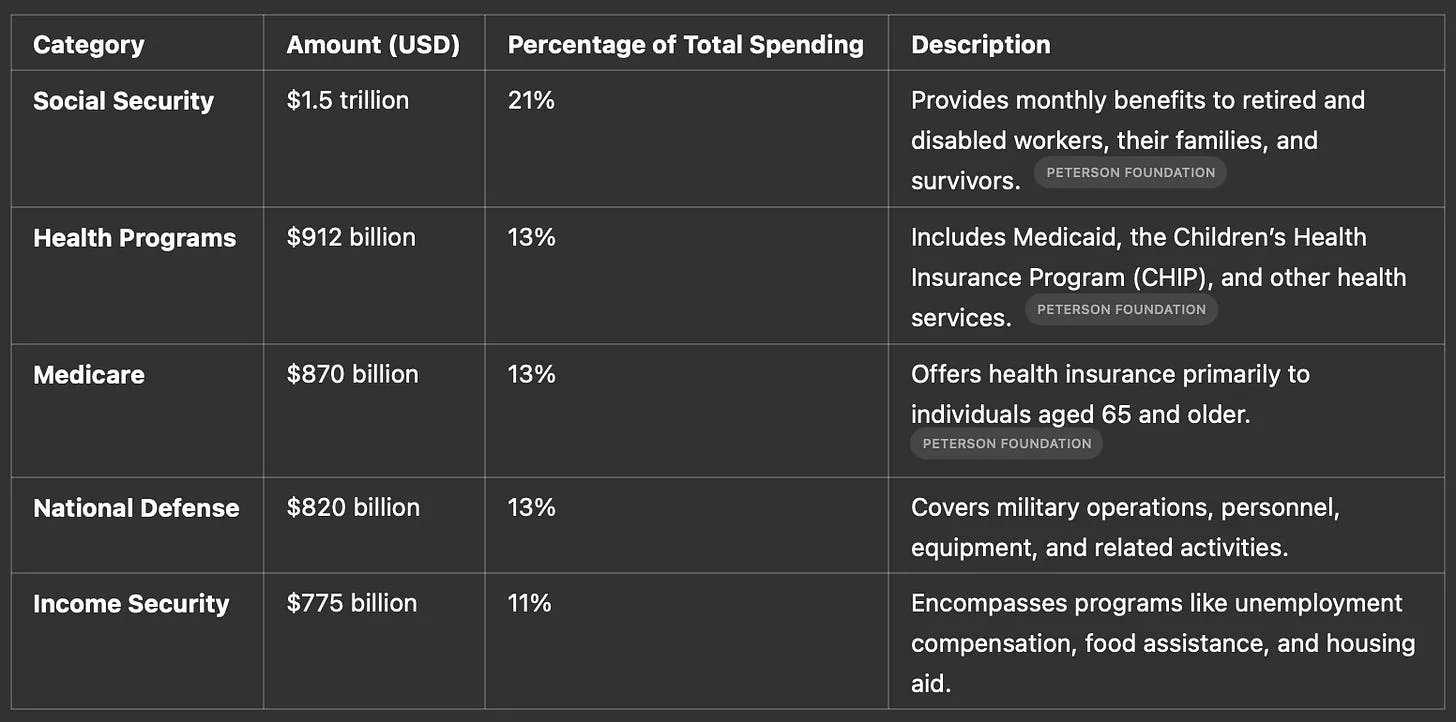
Mr. O: Right. Where does most of the U.S. government’s money go today?
Me: The biggest chunk — 21%, around $1.5 trillion — goes to Social Security. That’s why Elon has been digging into misallocated pension spending. Another major line is income security, and Trump’s crackdown on illegal immigration ties directly into reducing that.
Mr. O: So it all aligns. Can we draw more parallels between Trump’s policies and post-WWII UK?
Me: Let’s try. Two key tools that helped the UK were low interest rates and moderate inflation. Trump has been pressuring Powell for rate cuts — you can see the hints all over Truth Social. And on inflation, he’s openly admitted short-term pain may be necessary. He seems fine with it.
Mr. O: What about jobs and exports?
Me: That’s where reshoring comes in. Trump is pushing to bring factories back to the U.S., using tariffs as leverage. Some of his advisors even talk about replacing cheap overseas labor with robotics — advanced tech making reshoring viable.
Mr. O: Why can’t the U.S. just inflate the debt away?
Me: Because most of its debt is short-term and tied to interest rates. If inflation rises, rates rise too, making the debt more expensive. That’s a key difference — the UK had long-term loans with fixed terms, often 50+ years. The U.S. doesn’t.
But Trump might devalue the dollar instead. A weaker dollar makes debt easier to repay — and boosts exports.
Mr. O: He’ll almost have to devalue. Exports can’t take off with a strong dollar. And we’ve already seen hints.
Me: Yeah. I’m fairly convinced that’s part of the plan.
Mr. O: Maybe Trump will even try to restructure U.S. debt — like banks did during COVID. Remember how Equitas SFB restructured 90% of its loans?
Me: Could be. Japan and China each hold about $1 trillion of U.S. debt. Trump might negotiate to restructure it over 50+ years, offering tariff concessions in return. That helps twice over: it eases U.S. debt pressure and keeps imports cheap.
Mr. O: That’s speculative, though.
Me: Everything we’re saying is speculative.
Mr. O: Lol.
Patterns emerging: what the dots reveal
After that conversation, one thing kept resurfacing: Trump’s core mission is reducing U.S. debt — not just through budget cuts, but by reshaping America’s global strategy. He’s drawing lessons from history, especially the UK’s post-empire recovery playbook, and adapting them to the modern American context.
If this theory holds, expect Trump’s future actions to align with six strategic pillars:
- End multilateralism — shift toward bilateral trade deals that directly boost U.S. exports, cutting out frameworks that don’t serve economic goals.
- Retract the global footprint — exit wars and conflicts, reduce deep-state operations. Like the UK post-WWII, shed the cost of global policing.
- Devalue the dollar — support export growth and ease the burden of dollar-denominated debt.
- Restructure U.S. loans — renegotiate with key creditors like Japan and China, extending maturities or exchanging concessions.
- Prolong low rates + moderately higher inflation — cheaper borrowing while inflation erodes the real debt.
- Tighten fiscal spending — cut expenditure wherever ROI is low or abuse is high.
The end of the world we knew
We’ve always lived under the shadow of a strong dollar — one that only grew stronger in times of global conflict. We thrived in a world of globalization.
But now we may be watching a slow fade into bilateralism.
And if the U.S. chooses not to keep borrowing endlessly, here comes the trillion-dollar question:
Who will provide liquidity to the world?
Will it be China? Europe? Someone else entirely?
Or… will humanity simply slow down?
One thing is clear — the world is changing. And it might never go back to what it was.
Mr. O and I will return with more conversations. Part 2 →
Credits: ARK Invest & Cathie Wood, Pinetree Macro & Ritesh Jain, Bridgewater Associates & Ray Dalio, Oaktree Capital Management & Howard Marks, among others. First published on Seeker Capital’s Substack.