Position of countries, trade & liquidity in the new equation
The dollar-fed hierarchy is giving way to peer-to-peer liquidity, regional hegemons, and reciprocal demand — and India may be the biggest winner.
Part 3 of the New World Equation series. Part 2 is here.
In the second part of this series, I explained how Donald Trump’s core intent is to shut off the United States’ global liquidity tap — a tap that once fueled global prosperity and underpinned America’s diplomatic dominance, at the cost of an ever-growing U.S. debt burden.
Trump’s view is straightforward: U.S. debt is reaching an unsustainable level, and buyers for U.S. bonds are steadily shrinking — evident in five years of rising bond yields. Left unchecked, this trajectory could cripple the country. For Trump, the time to act is now. The liquidity tap must be closed.
And with that decision, the world has changed.
We no longer live in the post-WWII order, or even the post-Cold War “liberal globalized era.” This is a new world equation — one where liquidity no longer flows hierarchically. In this part, we’ll examine how countries are repositioning themselves, and how global trade and monetary alignment will reshape in response.
The flow of liquidity: old vs. new
For any kind of prosperity — global or national — money has to come from somewhere.
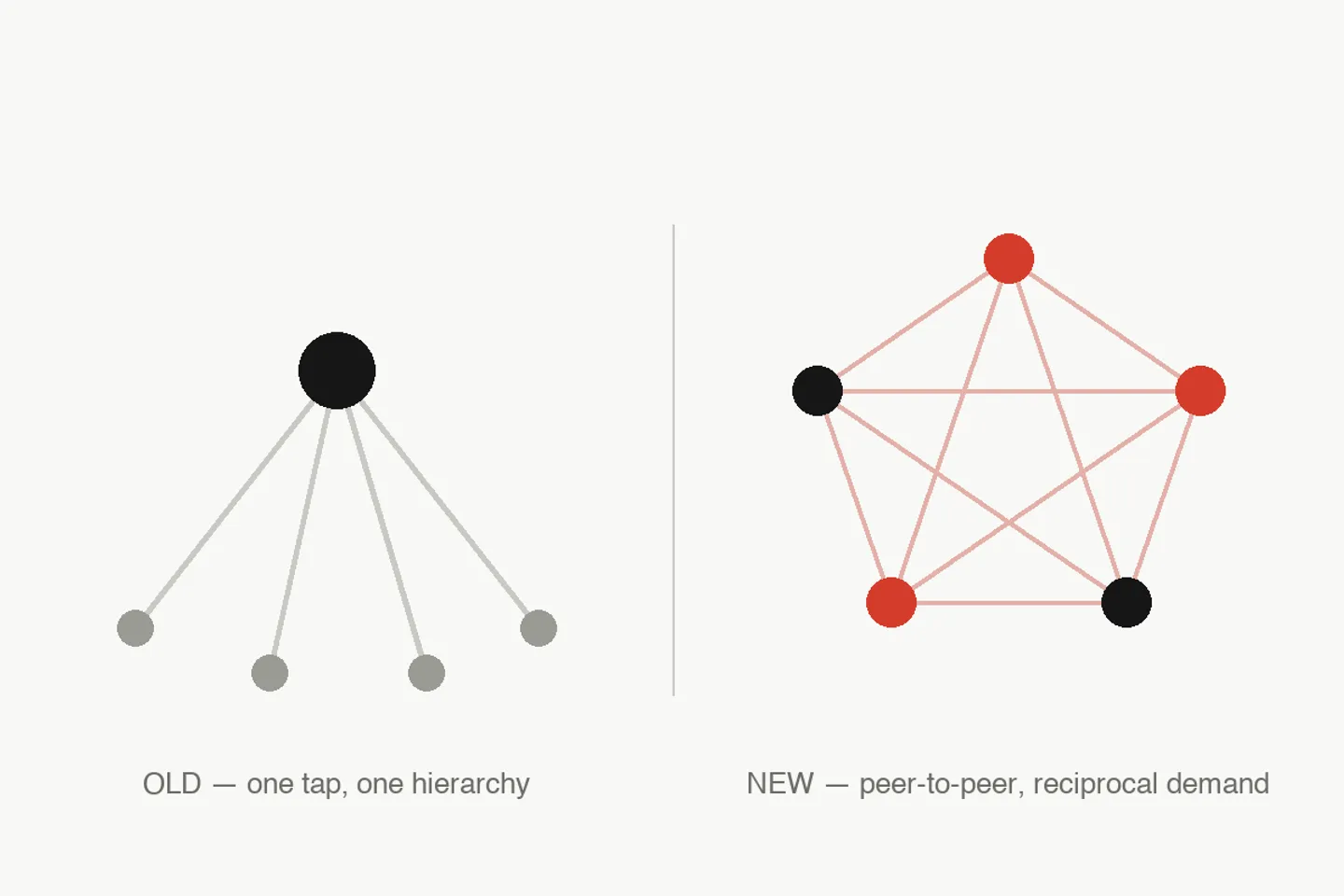
In the old equation: the United States acted as the world’s central node of liquidity. It pulled money from its future — issuing debt, selling Treasuries, borrowing heavily — and brought that liquidity into the present. That money created demand, which sustained global production and growth.
Countries like China and Vietnam never had to solve the most difficult problem in economics: demand. Their role was simply to produce. The U.S. outsourced its demand to them — strategically, in China’s case. That export of American demand let manufacturing economies thrive without ever building mature domestic consumption.
In the new equation: the U.S. is no longer willing to export demand unconditionally. The era of one-way liquidity is ending. From now on, America will selectively export demand only to countries capable of exporting demand back. The new system is built on reciprocal demand — not reciprocal tariffs, whatever the media narrative says.
That’s a massive problem for China and Vietnam, whose economic models run on imported demand. They now confront the missing half of their equation: how to create and sustain demand from within.
Liquidity flow is no longer hierarchical or unidirectional. It is becoming bi-directional — peer to peer. This isn’t a change in trade policy; it’s a structural realignment of how global prosperity is built.
Why China can’t be the next USA (for now)
As the U.S. steps back — weighed down by unsustainable debt, deindustrialization, and slowdown — a natural question arises: will China step in as the new global leader?
My answer: no — at least not for now. Two fundamental reasons.
1. China lacks the monetary framework of demand export
The U.S. became the center of the global economy not just because it produced wealth, but because it consumed it. America flooded the world with dollars by being a super-consumer, and simultaneously created demand for the dollar by issuing an ever-growing supply of Treasuries to absorb global liquidity. It opened its own market to the world and willingly shared its GDP.
For China to replicate that, it would first have to solve its own domestic demand problem — then go further and generate global demand for the yuan. But China is nowhere near consumption-led growth; its economy still leans on production and exports. And even with an internal demand engine, it would need to demonstrate a willingness to flood the world with yuan — issuing massive debt and building liquidity pipelines others can plug into.
There’s no indication China is ready for that leap.
2. Global leadership requires paying for war — a cost China may not bear
The role of global leader doesn’t come cheap. It demands not just economic strength but the willingness to fund, fight, and sustain endless geopolitical conflict. After WWII, the U.S. was uniquely positioned: an untouched industrial base, massive gold reserves, and the political will to finance interventions, establish bases, and enforce a world order aligned with its values.
The U.S. spent trillions over decades — Korea to Iraq — securing trade routes, defending allies, policing the international system. That spending wasn’t optional. It was the cost of anchoring the global order.
Now ask: is China ready to pay that price? With debt-to-GDP already around 130% (including local government debt), does Beijing want to stretch further to maintain military presence across continents, fund proxy wars, and secure global choke points the way the U.S. Navy does?
Leadership isn’t about GDP or manufacturing dominance — it’s about willingly bearing the cost of order in other people’s backyards. China hasn’t shown that willingness, and may simply not afford it, politically or economically.
The era of regional hegemons
As the U.S. steps back from enforcing hierarchy, and China remains unprepared to take its place, the world begins to resemble something far more natural: a jungle.
In this environment, power is regional. The strong dominate their zones. The weak align, submit, or survive carefully.
Consider: how did a small country like Ukraine summon the courage to defy Russia, flirt with NATO, and resist invasion? Only because, in the old equation, there was a global protector called the United States. The same goes for many small nations that acted boldly — the American gun stood behind them.
That gun is slowly being holstered.
In the new jungle, the deer no longer mocks the tiger — unless it’s under the protection of another tiger. This is the return of natural balance: small nations must respect, or strategically align with, their bigger neighbors. Only those with powerful patrons will assert themselves.
Who will the hegemons be? Perhaps the ones who can do all three:
- Manufacture and produce
- Generate their own internal demand
- Defend their territory without relying on anyone else
The countries that clearly qualify: China, Russia, India, the United States — possibly France or Germany, once they fix their military dependence on the U.S.
Everyone else — the “minion countries” — will have to choose sides, aligning with a hegemon for protection, trade access, and strategic cover.
Why India is a potential winner
Going by media narratives, it might seem puzzling: why is the U.S. targeting Vietnam even though Vietnam has cut tariffs on U.S. goods to nearly zero? Isn’t that what Washington wants?
Vietnam has functioned largely as a broker economy — importing heavily from China, exporting massively to the U.S. In essence: China supplies, America pays, Vietnam profits in between. That worked in the old world. In the new equation, the U.S. isn’t interested in one-sided relationships.
Washington now wants mutual demand-sharing. If it imports from a country, it expects that country to have the capacity — and willingness — to import back. Ask yourself: if America imports so much from Vietnam, what can Vietnam import in return? Not much. It simply doesn’t have the internal demand. That’s why it’s being dropped.
So who benefits? Countries that can export demand back to the U.S. And for that, a country needs real domestic demand.
That’s where India stands out.
India has internal demand — and, more importantly, the autonomy to use it. It isn’t under the thumb of any bloc. It crafts its own policies and negotiates from independence. That gives India the unique ability to offer demand access to partners like the U.S. — for energy, defense tech, services, consumer goods.
As the U.S. pulls demand away from China, Mexico, and Vietnam, India is positioned to take that seat at the table:
- A non-aligned nation
- A demand-rich economy
- A militarily secure country
- A young, educated population
India has nearly all the ingredients to strike strong, future-facing trade deals — not just with the U.S., but with every major hegemon in this multipolar world.
Two counterarguments — and why they don’t hold
1. “India isn’t a manufacturing powerhouse.” True — India isn’t at China’s level yet. But neither was China at the beginning. China became the factory of the world after it consistently received global demand. India is already on that path — exporting competitively, building capacity through joint ventures, PLIs, and technology transfer. With steady demand inflows, capability follows.
2. “The U.S. will manufacture for its own demand.” Not possible. The U.S. may reshore critical manufacturing, but it can’t do everything. At ~$85,000 per-capita income, America cannot afford the low- and mid-tier manufacturing that India, at ~$2,500 per capita, can take on efficiently. The U.S. will focus on high-tech and strategic sectors — but vast swathes of consumer goods, support services, and industrial components will still be outsourced.
In short: India is uniquely positioned — able to export demand, maintain policy independence, and build strong bilateral relationships. In the new world equation, India isn’t just surviving. It has the potential to thrive.
First published on Seeker Capital’s Substack.